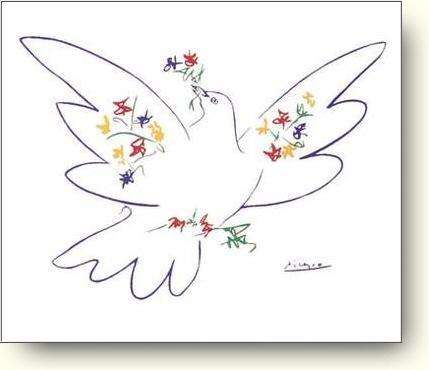
peace
Peace can be easily defined. All one has to do is head to any number of online dictionaries. I chose Webster’s Online Dictionary as my source and this is what it gave me:
Peace
Noun
1. The state prevailing during the absence of war.
2. Harmonious relations; freedom from disputes;
3. The absence of mental stress or anxiety.
4. The general security of public places;
5. A treaty to cease hostilities;
Pretty Strait forward and simple really. We all know what it means. We scream for it. We chant it. We want desperately to bring it to our lives and our world, and yet I think we have no idea how to actually make it happen.
Sure, we can rally to stop the war, we can hold placards, we can scream and shout and make an all around ruckus, but in the end this will not bring about peace. In fact, it will do quite the opposite.
Imagine a park, on a summer afternoon, quiet, still, and peaceful, then the thunderous roar of 1,000 people disrupting the peace, to chant for peace. The Police are called in. There is tear gas, knight sticks, and arrests.
Is this peace? This is nothing more than a small scale war. This is nothing more than Invading Iraq for peace. This, my friends, is not how we bring about peace.
So how do we do it?
Before I get into that, I have to stop for just a moment and make something very clear. I am no authority on this subject. This is just my opinion – one born of reading, thinking, and considering. In the end, it means nothing.
My opinion on how peace comes about is somewhat different and a bit more difficult to accept. We as a nation, meaning those of us in the U.S.A, tend to like the easy way out of things. If something is happening we don’t like, we stop it; if the kids are annoying us, we ground them; if there is a bug on the wall, we kill it. These are the simple easy fixes, but they do not solve the underlying problem.
Ground the child and he will be in trouble again at some point. Killing the bug does not get rid of the infestation.
It is this kind of thinking that we must change. We must accept that if we are to bring about change – bring about peace – that what we have done up to this point has not worked. The simple solutions of war and violence have not worked.
If we can accept that what we have been doing has not worked, then we can accept that perhaps the opposite could. If violence has failed, perhaps nonviolence can work. If ignoring the humanitarian crisis’s of the world has failed, perhaps focusing more attention on them will work.
If the easy fixes of violence and war have failed, perhaps the difficult fixes – using kindness, compassion, and nonviolence – will work.
This, in my opinion, is how we spread peace.
We must change the way we think about the problems we face. If I suggest to you that in order to put out your burning house you should throw gasoline on it, you would tell me I am crazy. You know this will not work because you have been around fire and you know that adding fuel to it only makes It worse. The same goes for violence.
It is easy to answer violence with violence, but that only stop the problem for the moment.
Do you think there would be such discontent for the United States if we were accepting of the Muslim nations of the world? If, in the wake of 9/11, we had spent time talking with the Muslim nations and worked out a way to find Osama Bin Laden, as apposed to simply declaring war on Islamic nations and painting Islam as an enemy, would he Islamic people be more or less willing to help us?
This can only happen through a change in attitude by each one of us, individually. Compassion, tolerance, kindness and understanding cannot be legislated. It happens when the people of a nation come to the realization that what they are doing is wrong and they make an effort, as a whole, to be unwilling to accept violence and hatred.
If each one of us makes an effort, all on our own, to change the way we think, then change can happen. Look around you. Consider how many times a day you say “I hate this” or “I hate that”. Think about the fact that you would rather read a blog where two people are cussing at one another than this. Consider how you would rather kill a spider than take it outside.
I consider how I would rather tell a Christian I hate them, then to try and understand where they are coming from. Little change bring about big changes.
I have decide that I am to change the world, then I have to start with myself. This blog is an example of that.
Will you join me?
Saturday, November 10, 2007

religion as a catalyst for peace
A while back I went on a rampage and attacked Islam, Christianity, and Mormonism for all the silliness found in their texts. What I did not do, and what I should have done, was link them together by the underlying theme – Peace.
All religions want it. They all strive for it. It would seem to me, that with this common thread being a focal point, individually we can all began to accept one another.
Here are some examples of what I am talking about:
“And he shall judge among the nations, and shall rebuke many people: and they shall beat their swords into plowshares, and their spears into pruning hooks: nation shall not lift up sword against nation, neither shall they learn war any more.” From The Bible – Isaiah 2;4
“Fight in the way of Allah against those who fight against you, but begin not hostilities. Lo! Allah loveth not aggressors.” The Qur’an - 2:190
“And there was a strict command throughout all the churches that there should be no persecutions among them, that there should be an equality among all men;” Mosiah - 27:3
“May the Lord of day grant us peace. May the Lord of night grant us peace. May the Lord of sight grant us peace. May the Lord of might grant us peace. May the Lord of speech grant us peace. May the Lord of space grant us peace. I bow down to Brahman, source of all power. I will speak the truth and follow the law. Guard me and my teacher against all harm. Guard me and my teacher against all harm.” Hindu Text –Taittiriya Upanishad
“What is hurtful to yourself do not to your fellow man. That is the whole of the Torah and the remainder is but commentary” Torah - Talmud, Shabbat 31a.
This list is quite literally endless, as there are countless religions on this planet, both big and small, and they all go after one thing: Peace.
So, if this is the case, then what should we do?
Create one world religion? That surely would never work. Religion cannot be forced and is too imbedded in specific cultures. Besides that, tying to convince an atheist, like me, to believe in any God is just a work in futility and vice-versa.
I would think, and it would seem, that the only real way to use religion to foster peace is to learn and to teach acceptance. Too often religions get on superiority kicks and begin attacking other religions. Muslims attack Jews, Jews attack Muslim, Atheists attack Christians; Christians attack Catholics; Catholics attack Mormons, and so on and so on forever. What is missed in all this dogmatic squabbling is the similarities they each have with one another; the idea of God and pursuit of peace.
If religious teachers began teaching acceptance and tolerance, what would be the result? The followers would begin practicing acceptance and tolerance and the ideas of superiority would start to diminish. Once that happened, the need to force ones religion on others would start to go away, Atheists would not feel threatened, Gays would be allowed to love, Christians could pray at school side by side with Muslims, and no one would care because no one would feel threatened.
This is how religion can bring peace.
In the past I have had great disdain for religion and in particular Christianity. As of lately I have tried hard to engage some Christian peacefully and share ideas with them and we have been able, on more than one occasion, to find common ground. The reason for this is that we did not feel threatened in our conversation because of their willingness to hear my point of view and accept it as nothing more than different.
If you are reading this, I hope you take something from it. I hope we can remember that no matter how much we believe something, no matter how strongly we fight for something, there are always going to be people who feel just as strongly the opposite. The key is how we deal with one another. Do we fight about our differences or do we accept them as inevitable facts of life and move on?
In the end, my soul is mine, not yours, to protect. If I am wrong and the Christian is correct, I will go to hell. I have accepted that. There is nothing left to argue about.
All religions want it. They all strive for it. It would seem to me, that with this common thread being a focal point, individually we can all began to accept one another.
Here are some examples of what I am talking about:
“And he shall judge among the nations, and shall rebuke many people: and they shall beat their swords into plowshares, and their spears into pruning hooks: nation shall not lift up sword against nation, neither shall they learn war any more.” From The Bible – Isaiah 2;4
“Fight in the way of Allah against those who fight against you, but begin not hostilities. Lo! Allah loveth not aggressors.” The Qur’an - 2:190
“And there was a strict command throughout all the churches that there should be no persecutions among them, that there should be an equality among all men;” Mosiah - 27:3
“May the Lord of day grant us peace. May the Lord of night grant us peace. May the Lord of sight grant us peace. May the Lord of might grant us peace. May the Lord of speech grant us peace. May the Lord of space grant us peace. I bow down to Brahman, source of all power. I will speak the truth and follow the law. Guard me and my teacher against all harm. Guard me and my teacher against all harm.” Hindu Text –Taittiriya Upanishad
“What is hurtful to yourself do not to your fellow man. That is the whole of the Torah and the remainder is but commentary” Torah - Talmud, Shabbat 31a.
This list is quite literally endless, as there are countless religions on this planet, both big and small, and they all go after one thing: Peace.
So, if this is the case, then what should we do?
Create one world religion? That surely would never work. Religion cannot be forced and is too imbedded in specific cultures. Besides that, tying to convince an atheist, like me, to believe in any God is just a work in futility and vice-versa.
I would think, and it would seem, that the only real way to use religion to foster peace is to learn and to teach acceptance. Too often religions get on superiority kicks and begin attacking other religions. Muslims attack Jews, Jews attack Muslim, Atheists attack Christians; Christians attack Catholics; Catholics attack Mormons, and so on and so on forever. What is missed in all this dogmatic squabbling is the similarities they each have with one another; the idea of God and pursuit of peace.
If religious teachers began teaching acceptance and tolerance, what would be the result? The followers would begin practicing acceptance and tolerance and the ideas of superiority would start to diminish. Once that happened, the need to force ones religion on others would start to go away, Atheists would not feel threatened, Gays would be allowed to love, Christians could pray at school side by side with Muslims, and no one would care because no one would feel threatened.
This is how religion can bring peace.
In the past I have had great disdain for religion and in particular Christianity. As of lately I have tried hard to engage some Christian peacefully and share ideas with them and we have been able, on more than one occasion, to find common ground. The reason for this is that we did not feel threatened in our conversation because of their willingness to hear my point of view and accept it as nothing more than different.
If you are reading this, I hope you take something from it. I hope we can remember that no matter how much we believe something, no matter how strongly we fight for something, there are always going to be people who feel just as strongly the opposite. The key is how we deal with one another. Do we fight about our differences or do we accept them as inevitable facts of life and move on?
In the end, my soul is mine, not yours, to protect. If I am wrong and the Christian is correct, I will go to hell. I have accepted that. There is nothing left to argue about.
peace and justice
Most people are of the assumption that peace and justice go hand in hand. It would almost seem as if they have to but I want you consider the quote I found on the internet today. I am not sure who said/wrote it, so if any one knows, please tell me so I can properly quote them..
“If one believes that the only way to prevent injustice and create justice is by force, then one believes that justice requires hostilities, which precludes peace”
It’s an amazing thought really. Think about all that we do in the name of justice:
The death penalty
War
Torture
Riots
The actions, as the quote says, “preclude peace.” How can we truly be a peaceful nation if we are using violence as means of justice?
The plain answer is, we cannot.
We cannot, as I have said before, continue to go through the same motions, in every situation; reacting the same way to everything; and expect a different result.
This goes back to my fundamental point of a mental shift, and the extreme need for it.
If every time a foreign government does something we do not agree with, we, in the name of justice, send troops and missiles to handle the situation, can there ever be peace?
We have to find a way to bring about justice without imposing brute force. The fact that this can be done is evident when one looks at Gandhi’s struggle to free India, and more recently with the disarmament of North Korea’s nuclear ambitions through diplomacy.
The same can be said for all aforementioned ideas.
When I talk about rioting and protesting I do not mean that we as a people should simply keep our mouths shut and let the politicians do as they please. You will NEVER hear me say that. But it can be done in a manner which does not bring about violence.
Pelting rocks at police offers, screaming, and calling names is counterproductive to the goal of the protestors, and more often than not just makes them look silly.
Compare the actions of Dr. Martin Luther King during the 60’s when he fought so peacefully for equal rights for blacks, and the actions of those who participated in the Los Angeles riots. Who accomplished more?
Clearly, when it comes to the idea of torture, there are few who will defend it as an effective means of intelligence gathering. Proof of this can be found by talking to Army Col. Stuart Herrington, a military intelligence specialist who conducted interrogations in Vietnam, Panama and Iraq during Desert Storm, and who was sent by the Pentagon in 2003 to assess interrogations in Iraq.
Herrington says, torture is "not a good way to get information." In his experience, nine out of 10 people can be persuaded to talk with no "stress methods" at all. Asked whether that would be true of religiously motivated fanatics, he says that the "batting average" might be lower: "perhaps six out of ten." But what of the remaining four? Herrington says, “They'll just tell you anything to get you to stop."
The death penalty is a much more complicated subject; to complicated to dive into today; but which will perhaps be my next blog. I can say this though; I do not see it, nor is there any evidence, that it is an effective deterrent to violent crime.
Justice in America seems to be equated with revenge. In my opinion, this is just flat out wrong.
Locking Osama Bin Laden in prison for planning the attacks of 9/11/2001 would be justice. Killing him would be revenge and not even a little peaceful.
I hope someday our society may learn the difference and began to make a change, but clearly that change cannot come over night. It comes from people speaking out against the causes of violence and not allowing their actions to undermine peace in the name of justice.
“If one believes that the only way to prevent injustice and create justice is by force, then one believes that justice requires hostilities, which precludes peace”
It’s an amazing thought really. Think about all that we do in the name of justice:
The death penalty
War
Torture
Riots
The actions, as the quote says, “preclude peace.” How can we truly be a peaceful nation if we are using violence as means of justice?
The plain answer is, we cannot.
We cannot, as I have said before, continue to go through the same motions, in every situation; reacting the same way to everything; and expect a different result.
This goes back to my fundamental point of a mental shift, and the extreme need for it.
If every time a foreign government does something we do not agree with, we, in the name of justice, send troops and missiles to handle the situation, can there ever be peace?
We have to find a way to bring about justice without imposing brute force. The fact that this can be done is evident when one looks at Gandhi’s struggle to free India, and more recently with the disarmament of North Korea’s nuclear ambitions through diplomacy.
The same can be said for all aforementioned ideas.
When I talk about rioting and protesting I do not mean that we as a people should simply keep our mouths shut and let the politicians do as they please. You will NEVER hear me say that. But it can be done in a manner which does not bring about violence.
Pelting rocks at police offers, screaming, and calling names is counterproductive to the goal of the protestors, and more often than not just makes them look silly.
Compare the actions of Dr. Martin Luther King during the 60’s when he fought so peacefully for equal rights for blacks, and the actions of those who participated in the Los Angeles riots. Who accomplished more?
Clearly, when it comes to the idea of torture, there are few who will defend it as an effective means of intelligence gathering. Proof of this can be found by talking to Army Col. Stuart Herrington, a military intelligence specialist who conducted interrogations in Vietnam, Panama and Iraq during Desert Storm, and who was sent by the Pentagon in 2003 to assess interrogations in Iraq.
Herrington says, torture is "not a good way to get information." In his experience, nine out of 10 people can be persuaded to talk with no "stress methods" at all. Asked whether that would be true of religiously motivated fanatics, he says that the "batting average" might be lower: "perhaps six out of ten." But what of the remaining four? Herrington says, “They'll just tell you anything to get you to stop."
The death penalty is a much more complicated subject; to complicated to dive into today; but which will perhaps be my next blog. I can say this though; I do not see it, nor is there any evidence, that it is an effective deterrent to violent crime.
Justice in America seems to be equated with revenge. In my opinion, this is just flat out wrong.
Locking Osama Bin Laden in prison for planning the attacks of 9/11/2001 would be justice. Killing him would be revenge and not even a little peaceful.
I hope someday our society may learn the difference and began to make a change, but clearly that change cannot come over night. It comes from people speaking out against the causes of violence and not allowing their actions to undermine peace in the name of justice.
par for the course
I read it all the time as I am browsing blogs; it is repeated by conservative Americans time and time again; The United States of American is the greatest country on Earth.
I think, really, most of us living here in the U.S. have, at one time or another, considered ourselves lucky to have been born in a society that allows to do pretty much whatever we want, and to some extent most of us have probably even thought the slogan “Greatest country…” was fairly accurate. However, the more on what makes America great, the more I come to the conclusion that this country, with all its freedom, is only completely average.
Proof of the mediocrity of the so-called “great nation” can be found in its own Declaration of Independence, and is really what got me thinking about all of this in the first place. The declaration reads:
“We hold these truths to be self-evident, that all men are created equal, that they are endowed by their Creator with certain unalienable Rights, that among these are Life, Liberty and the pursuit of Happiness.--That to secure these rights, Governments are instituted among Men, deriving their just powers from the consent of the governed”
As I read that over and over again, replaying it like some sort of meditive mantra, the true meaning began to sink in. “we hold these truths to be self evident”.
When asked “why is America the greatest nation?” the first thought that comes to mind is the Bill of Rights; freedom. We in America believe that because we are free, we are better. That is that. But, by our own admission, freedom – which comes from granting rights – is a self evident truth.
That is to say, freedom is not a luxury, but rather an expected result of being born. Therefore, those nations whose citizens are most free are not doing anything special whatsoever.
You see, if there are certain “unalienable rights” and “self evident truths” then what do we have to be sp proud of? We are simply doing as is expected of us. The fact that other nations are below average certainly doesn’t assume us the position of being above average, does it?
Consider this: If you have two kids in a room. One child begins punching holes in the wall while the other child goes about his business. You would most certainly discipline the bad child, but would you praise the other child? Of course not! Not punching holes in the wall is expected, and as such is not worthy of praise.
The United States is the better of the two children; he isn’t punching holes in the wall, but that’s expected.
The point I am trying to make here, is that the United States, while it is a fine place to call home, is nothing we should be so proud of. The extreme nationalism that we see on a daily basis is so unfounded in any kind of reality, that I often wonder what else people would believe if we could simply get anchor men and women on the nightly news to read it.
It is naive to think that America is the only free country on this planet. The fact is that most advanced nations in the world, including France, England, Scotland, New Zealand, South Korea, India, and Japan to name a few, have a “bill of rights” on record that mirrors that of the one here in the United States.
Furthermore, the Intentional Declaration of Human rights has been signed and ratified by 132 nations. This declaration grants citizens of the signed nation’s rights pertaining to economic, social, cultural, civil, and political issues. What many Americans fail to understand, or even do they know about, is that after these basic rights, there are two optional protocols, neither of wihich are signed by the United States but which are signed the first by 85 nations the second by 28 nations.
Again, I am not saying the United States is an awful place to call home. But, we need to get over this idea that we are some how better or “more free” than other nations, simply because we allow people freedoms which should be granted to all people anyway.
Freedom, in my opinion, is like air. Horrible if you don’t have it, but nothing special if you do. It is a birth right. It is expected. It is not something to be proud of or something that makes us superior. It is an, as it is said, “self-evident”.
I think we should get down off our high-horse for a while and see what the view is like on an equal level.
I think, really, most of us living here in the U.S. have, at one time or another, considered ourselves lucky to have been born in a society that allows to do pretty much whatever we want, and to some extent most of us have probably even thought the slogan “Greatest country…” was fairly accurate. However, the more on what makes America great, the more I come to the conclusion that this country, with all its freedom, is only completely average.
Proof of the mediocrity of the so-called “great nation” can be found in its own Declaration of Independence, and is really what got me thinking about all of this in the first place. The declaration reads:
“We hold these truths to be self-evident, that all men are created equal, that they are endowed by their Creator with certain unalienable Rights, that among these are Life, Liberty and the pursuit of Happiness.--That to secure these rights, Governments are instituted among Men, deriving their just powers from the consent of the governed”
As I read that over and over again, replaying it like some sort of meditive mantra, the true meaning began to sink in. “we hold these truths to be self evident”.
When asked “why is America the greatest nation?” the first thought that comes to mind is the Bill of Rights; freedom. We in America believe that because we are free, we are better. That is that. But, by our own admission, freedom – which comes from granting rights – is a self evident truth.
That is to say, freedom is not a luxury, but rather an expected result of being born. Therefore, those nations whose citizens are most free are not doing anything special whatsoever.
You see, if there are certain “unalienable rights” and “self evident truths” then what do we have to be sp proud of? We are simply doing as is expected of us. The fact that other nations are below average certainly doesn’t assume us the position of being above average, does it?
Consider this: If you have two kids in a room. One child begins punching holes in the wall while the other child goes about his business. You would most certainly discipline the bad child, but would you praise the other child? Of course not! Not punching holes in the wall is expected, and as such is not worthy of praise.
The United States is the better of the two children; he isn’t punching holes in the wall, but that’s expected.
The point I am trying to make here, is that the United States, while it is a fine place to call home, is nothing we should be so proud of. The extreme nationalism that we see on a daily basis is so unfounded in any kind of reality, that I often wonder what else people would believe if we could simply get anchor men and women on the nightly news to read it.
It is naive to think that America is the only free country on this planet. The fact is that most advanced nations in the world, including France, England, Scotland, New Zealand, South Korea, India, and Japan to name a few, have a “bill of rights” on record that mirrors that of the one here in the United States.
Furthermore, the Intentional Declaration of Human rights has been signed and ratified by 132 nations. This declaration grants citizens of the signed nation’s rights pertaining to economic, social, cultural, civil, and political issues. What many Americans fail to understand, or even do they know about, is that after these basic rights, there are two optional protocols, neither of wihich are signed by the United States but which are signed the first by 85 nations the second by 28 nations.
Again, I am not saying the United States is an awful place to call home. But, we need to get over this idea that we are some how better or “more free” than other nations, simply because we allow people freedoms which should be granted to all people anyway.
Freedom, in my opinion, is like air. Horrible if you don’t have it, but nothing special if you do. It is a birth right. It is expected. It is not something to be proud of or something that makes us superior. It is an, as it is said, “self-evident”.
I think we should get down off our high-horse for a while and see what the view is like on an equal level.
kindness, selfishness, and immigration
I wondered today, as I made my way to the isle of where they hide the diaper rash ointment, why it is so hard for people to be nice to one another. It really is amazing that people will actually go out of their way to NOT be nice to someone; to not hold the door, let a person in front of them, etc…
Let me explain to you what I am talking about.
As I was pulling into the parking lot at the local grocery store, there was a young man with some sort of physical handicap pushing a long row of carts in from outside. I am sure you can all picture those guys who play “go-fer” after the carts.
Any way, as he struggled, and I mean really struggled with these carts, he finally approached the crosswalk. NOT ONE car stopped to allow him to cross. NOT ONE, until I pulled up. I watched as he tried to stop the momentum of the carts, and then get them going again as I waved him on. I still feel I should’ve gotten out and helped him.
Then, as I was walking to get in line to pay for my two carefully selected items, I noticed a man walking ahead of me, aimed at the same isle (as if we had a choice, there were only 2 open) with one item; a loaf of bread. That’s it. Just bread. A lady who was much close to the checkout clearly saw the man and hurried to the line, nearly falling on her face trying to get her first few items on the conveyer in an effort to secure her spot in line. The women literally had her cart heaping over with food.
Now, wouldn’t most sensible people have let the kid with the carts cross or the man with one item, go ahead of them? It isn’t as if waiting for an extra 30 seconds is going to have an impact on anything.
Seeing all this play out makes me wonder why we Americans have such a problem being nice to other people. We are raised in a society where people doing selfless acts are looked upon as heroes, so why isn’t random kindness more prevalent?
It is my opinion that we have such an inflated view of our own self importance, we deem giving up any amount of our time or energy, no matter how little it may be, to be wasteful. That is to say, we do not see other people as being nearly as important as our own selves.
Consider the women in line at the grocery store. She made the decision that her time was so much more valuable than anyone else’s, that she simply could not wait for the man with the bread to pay before she got her turn.
What causes this? Why are we Americans in such a hurry? Why this feeling of self importance?
I try, when I think about these things, to look at small situations – such as the grocery store – and imagine how that mental attitude affects the world on a more grand scale. I try to consider the problems of the world; the “hot button issues”; and how they relate to mental attitudes.
In this situation, as I think of how self-important that women must have felt, or those people in too big of a hurry to let the young man cross the street, I wonder if this is a prevailing attitude or if it just a small, isolated incident.
As I thought about the, the idea of self importance, the extreme nationalism of this nation kept creeping into the back of my head.
Is self importance, or the idea that you are more important than me, what leads to this nationalistic pride?
Think about all the time people say this is “their” country, “their” city, “ their” state. Think of the people pushing to make English the official language of the United States and backing it up with things like “if you are going to come to my country, you should have to speak my language.”
This is insane. This is sense of self importance, this sense of MY, MY, ME, ME, is out of control completely. Americans are getting all up-in-arms about immigration because people are coming across the border illegally, yet they never stop to consider how bad those people actually have it. All they can think is, “they should speak my language.”
Some might say it is a bit of a stretch linking immigration to American self-centeredness, but I think the roots of the immigration issue are found at the very heart of it. Too often we hear about the loss of “American” jobs, we hear people complain, saying things like “well, if I have to pay taxes so should they”. Could you imagine if the people of Mexico had the same attitude saying things like, “well if I have to live in poverty, so should Americans!” ?
I am convinced, in case the point has not been made, that a lot of the problem could be fixed if our way of thinking changed. If we stop, just for a minute, and think of other people first instead of ourselves, I think we might just realize that we should be doing more to help people than worrying about whether or not they can speak “our” language, pay taxes, or any of the sort.
I will get off my soap box hear with one last statement. You Americans, who worry so much about losing jobs to illegal immigration, tell me, when was the last time you worked a tobacco farm 10 hours for 5 dollars an hour? When was the last time you risked prison to do so?
Let me explain to you what I am talking about.
As I was pulling into the parking lot at the local grocery store, there was a young man with some sort of physical handicap pushing a long row of carts in from outside. I am sure you can all picture those guys who play “go-fer” after the carts.
Any way, as he struggled, and I mean really struggled with these carts, he finally approached the crosswalk. NOT ONE car stopped to allow him to cross. NOT ONE, until I pulled up. I watched as he tried to stop the momentum of the carts, and then get them going again as I waved him on. I still feel I should’ve gotten out and helped him.
Then, as I was walking to get in line to pay for my two carefully selected items, I noticed a man walking ahead of me, aimed at the same isle (as if we had a choice, there were only 2 open) with one item; a loaf of bread. That’s it. Just bread. A lady who was much close to the checkout clearly saw the man and hurried to the line, nearly falling on her face trying to get her first few items on the conveyer in an effort to secure her spot in line. The women literally had her cart heaping over with food.
Now, wouldn’t most sensible people have let the kid with the carts cross or the man with one item, go ahead of them? It isn’t as if waiting for an extra 30 seconds is going to have an impact on anything.
Seeing all this play out makes me wonder why we Americans have such a problem being nice to other people. We are raised in a society where people doing selfless acts are looked upon as heroes, so why isn’t random kindness more prevalent?
It is my opinion that we have such an inflated view of our own self importance, we deem giving up any amount of our time or energy, no matter how little it may be, to be wasteful. That is to say, we do not see other people as being nearly as important as our own selves.
Consider the women in line at the grocery store. She made the decision that her time was so much more valuable than anyone else’s, that she simply could not wait for the man with the bread to pay before she got her turn.
What causes this? Why are we Americans in such a hurry? Why this feeling of self importance?
I try, when I think about these things, to look at small situations – such as the grocery store – and imagine how that mental attitude affects the world on a more grand scale. I try to consider the problems of the world; the “hot button issues”; and how they relate to mental attitudes.
In this situation, as I think of how self-important that women must have felt, or those people in too big of a hurry to let the young man cross the street, I wonder if this is a prevailing attitude or if it just a small, isolated incident.
As I thought about the, the idea of self importance, the extreme nationalism of this nation kept creeping into the back of my head.
Is self importance, or the idea that you are more important than me, what leads to this nationalistic pride?
Think about all the time people say this is “their” country, “their” city, “ their” state. Think of the people pushing to make English the official language of the United States and backing it up with things like “if you are going to come to my country, you should have to speak my language.”
This is insane. This is sense of self importance, this sense of MY, MY, ME, ME, is out of control completely. Americans are getting all up-in-arms about immigration because people are coming across the border illegally, yet they never stop to consider how bad those people actually have it. All they can think is, “they should speak my language.”
Some might say it is a bit of a stretch linking immigration to American self-centeredness, but I think the roots of the immigration issue are found at the very heart of it. Too often we hear about the loss of “American” jobs, we hear people complain, saying things like “well, if I have to pay taxes so should they”. Could you imagine if the people of Mexico had the same attitude saying things like, “well if I have to live in poverty, so should Americans!” ?
I am convinced, in case the point has not been made, that a lot of the problem could be fixed if our way of thinking changed. If we stop, just for a minute, and think of other people first instead of ourselves, I think we might just realize that we should be doing more to help people than worrying about whether or not they can speak “our” language, pay taxes, or any of the sort.
I will get off my soap box hear with one last statement. You Americans, who worry so much about losing jobs to illegal immigration, tell me, when was the last time you worked a tobacco farm 10 hours for 5 dollars an hour? When was the last time you risked prison to do so?
indifference
I have said before, and I think it is fundamental to the peace movement, that peace starts with a change of attitude in each one of us.
One of the hurdles we MUST overcome if we are to advance as a civilization is our callous indifference towards other living beings. We are not willing to put our selves out on a limb and show any kind of compassion towards others because, when we do, we are seen as weak; especially men.
When I tell people I cried the first time I heard a pig scream, they almost always make fun of me. Not because they really think it is funny, but because they use that as a way to hide their own feelings of sorrow. The idea that compassion is looked upon as weakness has caused us to train ourselves to be indifferent.
Another cause of indifference is our own selfishness. 80% of the wealth of the world is controlled by 10% of its population. That, to me, is an almost unfathomable statistic. I look at the richest people in the U.S.; at how they live, the way they spend, etc…; and I think, “My god, how do they sleep at night?”
Their indifference is fueled by selfishness and greed. It is fueled by the idea that their own personal possessions are more important than the wellbeing of others.
Consider that this year Tiger Woods will make 100 MILLION dollars. That is $273,972 A DAY for ONE SINGLE PERSON!
How, if there is that kind of money floating around, is homelessness and hunger still a problem in the world?
Complete and total indifference.
It may seem strange that I would talk about hunger and homelessness with regard to peace, but it all ties in with indifference.
In war, they call the innocent children killed by wayward bullets “collateral damage” and they talk about them as an inevitable cost of war. If people were unwilling to accept this; unwilling to be indifferent toward innocent people dying; war could not take place – everyone would be too worried about killing an innocent person, and thus unable to fire their weapon.
These ideas that I offer are too often dismissed as “Wishful thinking” and unrealistic. This goes to show that a change in mentality IS in fact needed. It is sad and disheartening that saying “compassion could end war” is looked at as a childish notion when, really, it is the only thing that could work.
I challenge anyone who reads this to look at their lives and examine their own indifference on a daily basis.
Can you spare a dollar for the homeless guy? Can you give can goods to a shelter? Can you do something so small as to not kill the spider in your living room?
All these things lead to a change in attitude and if you believe as I do – that a change is needed – then how can you not at least make an effort?
One of the hurdles we MUST overcome if we are to advance as a civilization is our callous indifference towards other living beings. We are not willing to put our selves out on a limb and show any kind of compassion towards others because, when we do, we are seen as weak; especially men.
When I tell people I cried the first time I heard a pig scream, they almost always make fun of me. Not because they really think it is funny, but because they use that as a way to hide their own feelings of sorrow. The idea that compassion is looked upon as weakness has caused us to train ourselves to be indifferent.
Another cause of indifference is our own selfishness. 80% of the wealth of the world is controlled by 10% of its population. That, to me, is an almost unfathomable statistic. I look at the richest people in the U.S.; at how they live, the way they spend, etc…; and I think, “My god, how do they sleep at night?”
Their indifference is fueled by selfishness and greed. It is fueled by the idea that their own personal possessions are more important than the wellbeing of others.
Consider that this year Tiger Woods will make 100 MILLION dollars. That is $273,972 A DAY for ONE SINGLE PERSON!
How, if there is that kind of money floating around, is homelessness and hunger still a problem in the world?
Complete and total indifference.
It may seem strange that I would talk about hunger and homelessness with regard to peace, but it all ties in with indifference.
In war, they call the innocent children killed by wayward bullets “collateral damage” and they talk about them as an inevitable cost of war. If people were unwilling to accept this; unwilling to be indifferent toward innocent people dying; war could not take place – everyone would be too worried about killing an innocent person, and thus unable to fire their weapon.
These ideas that I offer are too often dismissed as “Wishful thinking” and unrealistic. This goes to show that a change in mentality IS in fact needed. It is sad and disheartening that saying “compassion could end war” is looked at as a childish notion when, really, it is the only thing that could work.
I challenge anyone who reads this to look at their lives and examine their own indifference on a daily basis.
Can you spare a dollar for the homeless guy? Can you give can goods to a shelter? Can you do something so small as to not kill the spider in your living room?
All these things lead to a change in attitude and if you believe as I do – that a change is needed – then how can you not at least make an effort?
the anit-peace
It is a sad reality of this world that some people are so ignorant that they view other beings as less than them. When this topic is mentioned we often, almost immediately, conjure up images of Hitler and his Nazis, or early American slaves owners, and we think, “Yes, people are stupid”, but seldom do we stop to think about our own feelings of superiority.
You might be one to sit there and think, “I do not believe I am better than anyone else”, and you may very well believe that, but when we boil everything down to the basics, we are all just as guilty as anyone.
As previously mentioned, the easy examples of “I am better than you” appear on a grand scale when we think of the Nazis and what they did to the Jews, Gypsies, Gays, and pretty much anyone else who crossed their paths, but the smaller scale feeling of superiority are much more difficult to see, and, as I have found, much more difficult to admit to.
Let us take for example the current world climate, or, rather, the war in Iraq. I should note that this is not an anti-war blog – it Is just an example.
While many call for peace and are advocating bringing the troops home, they will say in the same breath, “..but I support our troops”. This “support” as it is, comes from a feeling of superiority; the idea that Americans should not have to die. That is not to say all people think this way, but I would say a majority do.
We will look at the death of the 3,000 American troops and be absolutely devastated (as we should be) but rarely bat an eye at the death of a so-called “insurgent” or “terrorist”. Why is that? They are human. They are fighting for the same thing we say we are fighting for – freedom - , thus, there cause is, for all intents and purposes, just as noble, so why are we not saddened by their deaths?
Is it because we didn’t know them? I doubt it. Many people are saddened by the death of the American troops, yet they knew none of them. So, why then, do the deaths of the Iraqis mean nothing to us?
Because they are Iraqis. They are not “us”. We have a “right” to kill them because they are trying to kill Americans. It is justified. This is the feeling of “we are better than others” that I am talking about.
Another great example that is relevant to today’s world is the issue of immigration. I have talked about this before when referring to the idea of selfishness, but it becomes quite clear that even the most unselfish people still believe that “Mexicans” and taking jobs from “Americans” , as if to say that being born a foot north or south of a manmade, imaginary, line somehow entitles one to a job and not another.
This again is a feeling of superiority; the belief that Americans are better than Mexicans – and perhaps not even better per-se, but certainly more entitled to.
These examples may not be on a scale of WWII era genocide, but they are certainly much bigger than you an me. They are easy to see and even easier to remove ones self from. We can all sit back and easily say “I think Mexicans can have all the jobs they want, so I do not have this superiority complex” and in that sense you may be correct, which is, really, why looking at thing on such a grand scale is a complete waste of time, and is what brings me back to the idea of changing ones self for the betterment of the world.
Consider what follows, if you are one of those thinking, “HA! I do none of those things!”
A building is on fire. Inside the building, unable to escape, sits your mother and an unknown woman, of the exact same age. Who do you save?
What makes your mother more deserving to live than the other women?
Now, clearly this is an extreme example, and I am sure the answers could vary, but for most people, the obvious answer is to save Mom before anyone else. This is because we have an attachment to our mothers. Most people will see their mother to be more important than anyone else’s mother because it is their mother. This too, is a feeling of superiority – the feeling that one person is more important than another. I am certainly not saying we should all forsake our mothers, but hopefully I made my point.
Now, I could continue on, as my beliefs on this subject go even deeper to include ALL sentient beings, but much deeper into this becomes a religious issue, and for the moment I hope an understanding of what I am talking about has been attained.
This obvious feeling of attachment to one person over another based solely on superficialities is, in my opinion, what has lead us to the state this world is in today. Our belief that it is more offensive for an American to be killed than it is for someone of another country to be killed makes it much easier to justify war, because they are only Iraqis – Afghans – Germans – etc…
We tolerate the mistreatment of people from other parts of the world – like Darfur – when we would surely not tolerate the same treatment of Americans.
This must end. If we are ever to be a peaceful people, there is no choice but for us to make an effort to view all people as equal. Be they black, white, Asian – gay/strait – fat/skinny – rich/poor – Christian/Jew/Muslim/Buddhist/Atheist – we must change our attitude of indifference toward people based on the idea of them being “less than”.
We must realize that these borders we cling to so tightly, and put so much stock in, are irrelevant when it comes to the plight of the masses. Being born in America, or any other “free” nation, should not make one superior to another, rather, we should take the opportunity to use our wealth, prosperity, and liberty to aid in making this one world, one people, one race.
You might be one to sit there and think, “I do not believe I am better than anyone else”, and you may very well believe that, but when we boil everything down to the basics, we are all just as guilty as anyone.
As previously mentioned, the easy examples of “I am better than you” appear on a grand scale when we think of the Nazis and what they did to the Jews, Gypsies, Gays, and pretty much anyone else who crossed their paths, but the smaller scale feeling of superiority are much more difficult to see, and, as I have found, much more difficult to admit to.
Let us take for example the current world climate, or, rather, the war in Iraq. I should note that this is not an anti-war blog – it Is just an example.
While many call for peace and are advocating bringing the troops home, they will say in the same breath, “..but I support our troops”. This “support” as it is, comes from a feeling of superiority; the idea that Americans should not have to die. That is not to say all people think this way, but I would say a majority do.
We will look at the death of the 3,000 American troops and be absolutely devastated (as we should be) but rarely bat an eye at the death of a so-called “insurgent” or “terrorist”. Why is that? They are human. They are fighting for the same thing we say we are fighting for – freedom - , thus, there cause is, for all intents and purposes, just as noble, so why are we not saddened by their deaths?
Is it because we didn’t know them? I doubt it. Many people are saddened by the death of the American troops, yet they knew none of them. So, why then, do the deaths of the Iraqis mean nothing to us?
Because they are Iraqis. They are not “us”. We have a “right” to kill them because they are trying to kill Americans. It is justified. This is the feeling of “we are better than others” that I am talking about.
Another great example that is relevant to today’s world is the issue of immigration. I have talked about this before when referring to the idea of selfishness, but it becomes quite clear that even the most unselfish people still believe that “Mexicans” and taking jobs from “Americans” , as if to say that being born a foot north or south of a manmade, imaginary, line somehow entitles one to a job and not another.
This again is a feeling of superiority; the belief that Americans are better than Mexicans – and perhaps not even better per-se, but certainly more entitled to.
These examples may not be on a scale of WWII era genocide, but they are certainly much bigger than you an me. They are easy to see and even easier to remove ones self from. We can all sit back and easily say “I think Mexicans can have all the jobs they want, so I do not have this superiority complex” and in that sense you may be correct, which is, really, why looking at thing on such a grand scale is a complete waste of time, and is what brings me back to the idea of changing ones self for the betterment of the world.
Consider what follows, if you are one of those thinking, “HA! I do none of those things!”
A building is on fire. Inside the building, unable to escape, sits your mother and an unknown woman, of the exact same age. Who do you save?
What makes your mother more deserving to live than the other women?
Now, clearly this is an extreme example, and I am sure the answers could vary, but for most people, the obvious answer is to save Mom before anyone else. This is because we have an attachment to our mothers. Most people will see their mother to be more important than anyone else’s mother because it is their mother. This too, is a feeling of superiority – the feeling that one person is more important than another. I am certainly not saying we should all forsake our mothers, but hopefully I made my point.
Now, I could continue on, as my beliefs on this subject go even deeper to include ALL sentient beings, but much deeper into this becomes a religious issue, and for the moment I hope an understanding of what I am talking about has been attained.
This obvious feeling of attachment to one person over another based solely on superficialities is, in my opinion, what has lead us to the state this world is in today. Our belief that it is more offensive for an American to be killed than it is for someone of another country to be killed makes it much easier to justify war, because they are only Iraqis – Afghans – Germans – etc…
We tolerate the mistreatment of people from other parts of the world – like Darfur – when we would surely not tolerate the same treatment of Americans.
This must end. If we are ever to be a peaceful people, there is no choice but for us to make an effort to view all people as equal. Be they black, white, Asian – gay/strait – fat/skinny – rich/poor – Christian/Jew/Muslim/Buddhist/Atheist – we must change our attitude of indifference toward people based on the idea of them being “less than”.
We must realize that these borders we cling to so tightly, and put so much stock in, are irrelevant when it comes to the plight of the masses. Being born in America, or any other “free” nation, should not make one superior to another, rather, we should take the opportunity to use our wealth, prosperity, and liberty to aid in making this one world, one people, one race.
capital punishment is not peaceful
In a previous post I mentioned the death penalty as a deterrent to peace. The reason for this is simply really. The death penalty is a violent act carried out in the name of vengeance, under the guise of justice.
I have decided to forego throwing a ton of statistics at you, as I think it is important to talk about the rationality of capital punishment. If you think this is something better discussed with statistics and cold hard facts, then please, blog it and I come give you my take on it. For now, trying to gain an insight is all this is about.
Many people, be they religious or not, use the catch phrase “eye for an eye” when talking about capital punishment. For the most part we can take this to mean that if you kill someone, you will be killed.
It is interesting to me, however, that this is the ONLY situation in which this idea is an acceptable form of punishment. The penalty for punching someone in the face is not a punch in the face. The penalty for rape is not to be raped. The penalty for breaking someone’s window is not to have your windows broken.
Because these crimes are punishable by fines, community service, and/or jail time, and because people tend to accept them as valid forms of punishment, further proves that capital punishment is a form of revenge as apposed to justice.
Supporters of capital punishment say that a person who kills a child does not “deserve” to live. Therefore, they justify the use of the death penalty by saying that it is ridding the world of an evil person. There is no way that this can ever be an effective argument. The reality of it is, this case is based upon YOU, a human being, deciding who is worthy of life and death; is that not why murder is illegal, because we have decided that we are not the ones to make this decision?
A child murdered is indeed a sad thing. I could not imagine the death of one of my two kids at the hands of a murder, nor do I even enjoy entertaining the thought that it could happen. Children are innocent and undeserving of any such fate, without a doubt.
But imagine a world where this kind of logic justifies various acts.
Let me explain this with a hypothetical situation: Pretend that I am the ruler of the United States and a supporter of death penalty. Those of you who have known me for a while know that I am a vegan and firmly against animal testing because I believe it is the senseless killing of an innocent life, a.k.a murder.
Since I am now the ruler of the nation, anyone caught killing an animal is to be sentenced to death.
Is that right? My morality could justify my stance in this situation, if I was pro-capital punishment, but that does not make it right. To most of you this seems extreme, but to me, a life is a life, be it human or not.
It is clear that this kind of rationality simply does not hold up under closer examination.
You may be wonder at this point what all this has to do with Peace. Quite a bit really. I am sure if you have read the previous posts you already know what I am going to say; a change in thinking is desperately needed.
The death penalty is an act of vengeance. We could argue that all day long, but in the end, killing a killer is for the sole reason of making the victim’s family feel better. It is certainly not for the victim.
When people try to justify killing a killer they tend to look at the grief of the victims family, and somehow believe that revenge will make them feel better. I often wonder how the mother of killer feels. Is she to blame? Should she be forced to have her son taken from her?
This failure to recognize the guilty party as human, and as having a family and friends of their own, leads to much bigger problems on a much more grand scale.
Consider the acts of 9/11/2001. Americans, including myself, were absolutely outraged at the blatant disregard for human life. We each did our part to mourn the tremendous loss of life and think of the families of those victims.
Then, with no regard to the consequences, many, in fact the majority, in this country began to call for military action. Now, after the death of 3000 innocent Americans, a war based on what many call justice, but most are calling revenge, there have been between 74,000 and 81,000**.
This is because of the same mentality - the same vengeful ignorance – that keeps capital punishment legal in the United States and around the world.
Outlawing capital punishment, in my opinion, would, in the years to come, create a new way of thinking, especially within the youth. If killing as an act of justice is seen as wrong, immoral, and unjust, then perhaps war as an effective means of international problem solving could be seen in the same light as well.
I have decided to forego throwing a ton of statistics at you, as I think it is important to talk about the rationality of capital punishment. If you think this is something better discussed with statistics and cold hard facts, then please, blog it and I come give you my take on it. For now, trying to gain an insight is all this is about.
Many people, be they religious or not, use the catch phrase “eye for an eye” when talking about capital punishment. For the most part we can take this to mean that if you kill someone, you will be killed.
It is interesting to me, however, that this is the ONLY situation in which this idea is an acceptable form of punishment. The penalty for punching someone in the face is not a punch in the face. The penalty for rape is not to be raped. The penalty for breaking someone’s window is not to have your windows broken.
Because these crimes are punishable by fines, community service, and/or jail time, and because people tend to accept them as valid forms of punishment, further proves that capital punishment is a form of revenge as apposed to justice.
Supporters of capital punishment say that a person who kills a child does not “deserve” to live. Therefore, they justify the use of the death penalty by saying that it is ridding the world of an evil person. There is no way that this can ever be an effective argument. The reality of it is, this case is based upon YOU, a human being, deciding who is worthy of life and death; is that not why murder is illegal, because we have decided that we are not the ones to make this decision?
A child murdered is indeed a sad thing. I could not imagine the death of one of my two kids at the hands of a murder, nor do I even enjoy entertaining the thought that it could happen. Children are innocent and undeserving of any such fate, without a doubt.
But imagine a world where this kind of logic justifies various acts.
Let me explain this with a hypothetical situation: Pretend that I am the ruler of the United States and a supporter of death penalty. Those of you who have known me for a while know that I am a vegan and firmly against animal testing because I believe it is the senseless killing of an innocent life, a.k.a murder.
Since I am now the ruler of the nation, anyone caught killing an animal is to be sentenced to death.
Is that right? My morality could justify my stance in this situation, if I was pro-capital punishment, but that does not make it right. To most of you this seems extreme, but to me, a life is a life, be it human or not.
It is clear that this kind of rationality simply does not hold up under closer examination.
You may be wonder at this point what all this has to do with Peace. Quite a bit really. I am sure if you have read the previous posts you already know what I am going to say; a change in thinking is desperately needed.
The death penalty is an act of vengeance. We could argue that all day long, but in the end, killing a killer is for the sole reason of making the victim’s family feel better. It is certainly not for the victim.
When people try to justify killing a killer they tend to look at the grief of the victims family, and somehow believe that revenge will make them feel better. I often wonder how the mother of killer feels. Is she to blame? Should she be forced to have her son taken from her?
This failure to recognize the guilty party as human, and as having a family and friends of their own, leads to much bigger problems on a much more grand scale.
Consider the acts of 9/11/2001. Americans, including myself, were absolutely outraged at the blatant disregard for human life. We each did our part to mourn the tremendous loss of life and think of the families of those victims.
Then, with no regard to the consequences, many, in fact the majority, in this country began to call for military action. Now, after the death of 3000 innocent Americans, a war based on what many call justice, but most are calling revenge, there have been between 74,000 and 81,000**.
This is because of the same mentality - the same vengeful ignorance – that keeps capital punishment legal in the United States and around the world.
Outlawing capital punishment, in my opinion, would, in the years to come, create a new way of thinking, especially within the youth. If killing as an act of justice is seen as wrong, immoral, and unjust, then perhaps war as an effective means of international problem solving could be seen in the same light as well.
about hate
Continuing on my series of blogs on how I believe we can bring about peace, I am inevitably brought to the subject of hate.
Hatred, in my humble and meaningless opinion, is nothing more than a plague of human thinking; a virus with causes, and cures. It is, of all the emotions we feel, the only one that is taught and learned.
Think about it if you will. When watching small children play, we see happiness occur naturally. We see jealousy, fear, anger, and sadness all occur naturally. What we do not see is hatred. It is not natural. It is not a part of the human psyche until it is put there by some exterior influence.
Parents teach kids to hate from an early age. Everyone knows this. What we do not consider is how we teach our own selves to hate. We lie about the nature of our hatred and we use the sentence “I hate that” to cover up our own fears and insecurities because we are unwilling to let go our ignorance, or at least admit that it is there.
Look at the current climate in the United States. Hate has been woven into the very fabric of this society. It has been born of fear, a fear created for the purposes of political gain, and it has spread like wild fire through the entire country. Then, the fear, fueled by ignorance, allowed the Bush administration to plow forward, unchallenged, with their war profiteering agenda.
I am not trying to use this as a chance to attack Bush, I am simply saying ignorance = fear = hate = war; the opposite of peace; the point being that hate is not an emotion in and of itself, but dependent on other causes.
So how do we combat this? Education. Education. Education.
Look at hate groups in this country; the KKK, Hammerskins, Aryan’s, the Fred Phelps clan, and the people calling for the “nuking” of the Mid-East. If these people weren’t so ignorant, the hate they harbor would have no foundation, and therefore be unable to exist.
Thus, it is up to all of us to do our part to educate people. Killing hate starts with accepting that we cause it. We must let go this idea that hate will always be here; we must stop looking at it as a simple emotion and acknowledge that WE cause it and WE can cure it.
If there is a road to peaceful existence, then curing hatred has to be the foundation it is built upon.
I hope you think about this the next time you hear someone say they hate something. When you do, ask them, “Do you really?”
Hatred, in my humble and meaningless opinion, is nothing more than a plague of human thinking; a virus with causes, and cures. It is, of all the emotions we feel, the only one that is taught and learned.
Think about it if you will. When watching small children play, we see happiness occur naturally. We see jealousy, fear, anger, and sadness all occur naturally. What we do not see is hatred. It is not natural. It is not a part of the human psyche until it is put there by some exterior influence.
Parents teach kids to hate from an early age. Everyone knows this. What we do not consider is how we teach our own selves to hate. We lie about the nature of our hatred and we use the sentence “I hate that” to cover up our own fears and insecurities because we are unwilling to let go our ignorance, or at least admit that it is there.
Look at the current climate in the United States. Hate has been woven into the very fabric of this society. It has been born of fear, a fear created for the purposes of political gain, and it has spread like wild fire through the entire country. Then, the fear, fueled by ignorance, allowed the Bush administration to plow forward, unchallenged, with their war profiteering agenda.
I am not trying to use this as a chance to attack Bush, I am simply saying ignorance = fear = hate = war; the opposite of peace; the point being that hate is not an emotion in and of itself, but dependent on other causes.
So how do we combat this? Education. Education. Education.
Look at hate groups in this country; the KKK, Hammerskins, Aryan’s, the Fred Phelps clan, and the people calling for the “nuking” of the Mid-East. If these people weren’t so ignorant, the hate they harbor would have no foundation, and therefore be unable to exist.
Thus, it is up to all of us to do our part to educate people. Killing hate starts with accepting that we cause it. We must let go this idea that hate will always be here; we must stop looking at it as a simple emotion and acknowledge that WE cause it and WE can cure it.
If there is a road to peaceful existence, then curing hatred has to be the foundation it is built upon.
I hope you think about this the next time you hear someone say they hate something. When you do, ask them, “Do you really?”
Subscribe to:
Posts (Atom)